Residential Grease Trap Pumping in Indianapolis, IN
Indianapolis Residential Grease Trap Pumping
Residential Grease Trap Pumping Services in Indianapolis
Most homeowners in Indianapolis don’t think about their grease trap until a drain backs up, a foul smell starts creeping up from the kitchen sink, or a plumber tells them the line is completely blocked with hardened grease. By that point, what could have been a straightforward cleaning job has already turned into something bigger and more expensive. At Indianapolis Grease Trap Services, we provide professional residential grease trap pumping in Indianapolis, IN, and throughout Marion County, helping homeowners stay ahead of grease buildup before it causes real damage to their plumbing and drainage systems.
If your home has a grease trap — whether it was installed as part of the original build, added later, or required by your local municipality — keeping it pumped and cleaned on a regular schedule is one of the simplest ways to protect your pipes, your septic system, and your home’s overall plumbing health. Our owner-operated team serves neighborhoods across Indianapolis, from Broad Ripple and Irvington to Lawrence, Speedway, and communities throughout Marion County and beyond.
What Is a Residential Grease Trap and What Does It Do?
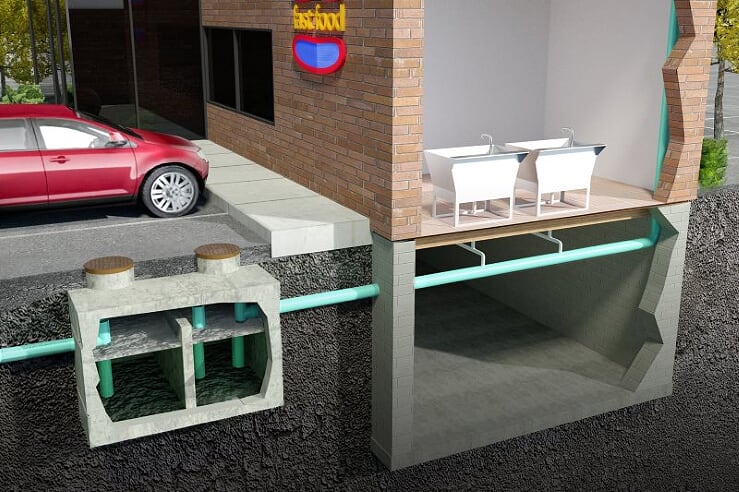
A grease trap, sometimes called a grease interceptor, is a plumbing device designed to capture fats, oils, and grease before they enter your main drain line or septic system. In a residential setting, grease traps are typically installed under the kitchen sink or outside the home near the foundation, positioned between the kitchen drain and the septic tank or municipal sewer connection.
Here’s the basic idea: when you wash dishes, rinse pots and pans, or run water down the kitchen drain, a mixture of water, food particles, and grease flows into the trap. Inside the trap, the grease and oils float to the top while heavier solids sink to the bottom. The relatively cleaner water in the middle flows out through the outlet pipe and continues to the septic system or sewer line.
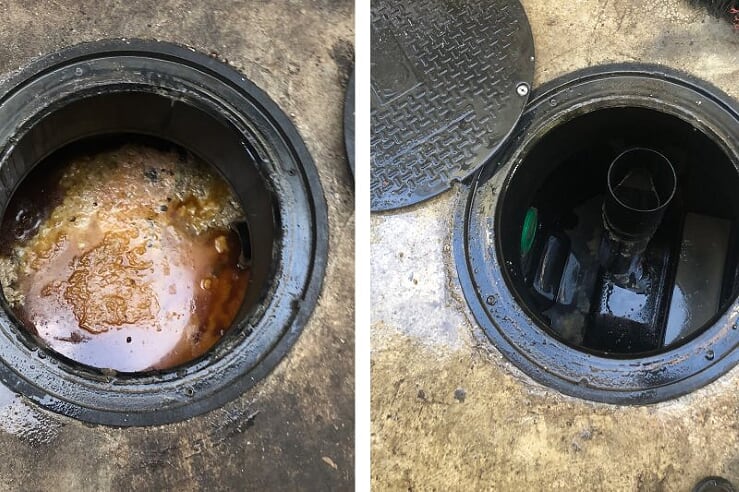
Over time, the grease layer at the top and the solids layer at the bottom both grow. When those layers take up too much space inside the trap, grease and solids start passing through into the drain line or septic system — exactly what the trap was installed to prevent. That’s when problems start: clogged pipes, slow drains, sewage odors, and in homes on septic systems, accelerated sludge buildup that shortens the life of the entire system.
Regular residential grease trap pumping removes those accumulated layers before they overflow, keeping the trap working the way it’s supposed to and protecting everything downstream.
Signs Your Residential Grease Trap Needs Pumping
Grease traps don’t announce when they’re getting full. Most homeowners don’t realize there’s a problem until the signs become hard to ignore. Here’s what to watch for:
- Slow kitchen drain – If your kitchen sink drains slowly and a standard drain cleaner or plunger doesn’t fix it, the issue may be further down the line in the grease trap itself. A trap that’s filling up restricts flow through the outlet pipe, causing water to back up.
- Grease or food odors coming from the drain – A clean, properly functioning grease trap contains waste but manages odors effectively. When the trap gets too full, decomposing grease and food solids produce hydrogen sulfide gas, which creates a strong, unpleasant smell that works its way back up through your kitchen drain.
- Gurgling sounds from the kitchen sink – Similar to what you’d hear from a full septic tank, gurgling from the kitchen drain often signals that air is being displaced by a restricted flow path somewhere in the system. A full or partially clogged grease trap is a common cause.
- Grease visible around the drain or trap lid – If you can see grease surfacing around the grease trap lid or backing up near the drain, the trap has exceeded its capacity and is no longer intercepting waste effectively.
- Frequent kitchen drain clogs – One clog might just be a clog. But if your kitchen drain clogs repeatedly over a short period of time, the underlying cause is often a grease trap that hasn’t been pumped and is no longer protecting your drain line.
- Your septic tank is filling faster than expected – For homes on septic systems, a grease trap that’s overflowing passes fats, oils, and food solids directly into the septic tank. If your septic tank seems to need pumping more frequently than your household size would suggest, the grease trap may be the reason.
How Residential Grease Trap Pumping Works
The process is straightforward, but it takes the right equipment and trained hands to do it properly. Here’s what happens when our team comes out to service your residential grease trap:
Step 1: Locating and Accessing the Trap
Our technician locates your grease trap, removes the lid, and assesses the current condition inside. We check the grease layer depth, solids accumulation at the bottom, and the condition of the inlet and outlet baffles that control flow through the trap.
Step 2: Pumping Out All Waste
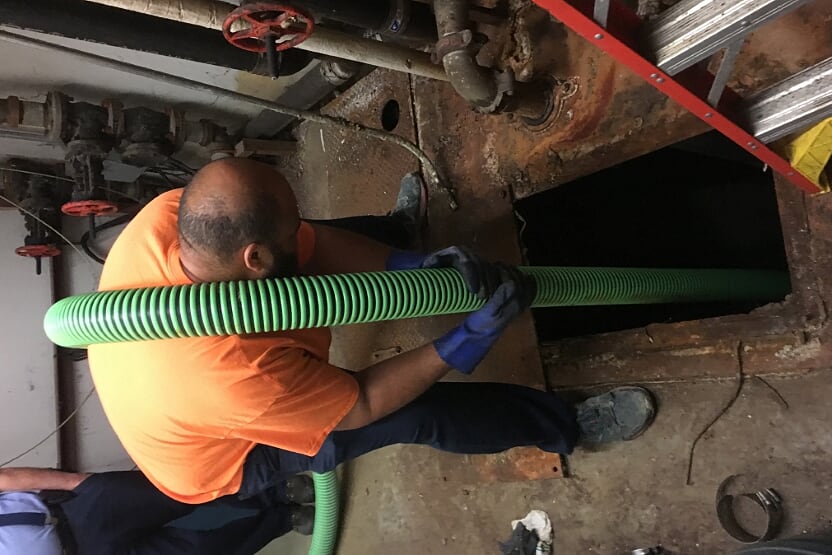
Using our vacuum truck equipment, we pump out all accumulated grease, oils, food solids, and wastewater from the trap. This is a complete cleanout — not a partial pump that leaves waste behind. Everything comes out, so the trap starts fresh.
Step 3: Scrubbing and Cleaning the Interior
After pumping, we scrub the interior walls, lid, and baffles of the trap to remove grease film, biofilm, and any residue that clings to surfaces after the bulk waste is removed. This step matters because leftover grease film breaks down quickly and accelerates the rate at which the trap refills between service visits.
Step 4: Baffle and Component Inspection
We inspect the inlet and outlet baffles for cracks, blockages, or deterioration. Baffles play an important role in how the trap separates grease from water — a damaged baffle means the trap isn’t working correctly, even when it’s not full. We also check the trap body for cracks or signs of structural wear.
Step 5: Waste Disposal
All grease, solids, and wastewater removed from your trap are transported and disposed of responsibly through licensed recycling and disposal facilities. We partner with facilities that repurpose grease waste as alternative fuel or soil additives wherever possible, keeping disposal as environmentally responsible as the job allows.
Why Residential Grease Traps Get Neglected — And Why It Matters
Grease traps in residential settings tend to get overlooked for a simple reason: they’re out of sight. They sit under the sink or are buried outside the home, doing their job quietly until they can’t anymore. Most homeowners aren’t told at the time of installation how often the trap needs to be serviced, and without that information, years can pass between cleanings.
Here’s why that matters practically:
When a residential grease trap overflows, grease doesn’t just disappear. It moves into your drain line, where it cools and hardens on the pipe walls. Over time that buildup narrows the pipe diameter and eventually causes a full blockage. Clearing a grease-impacted drain line costs significantly more than a routine grease trap pump-out, and in severe cases it requires hydro-jetting or pipe replacement.
For homes on septic systems, the impact is even more significant. Fats and oils entering a septic tank don’t break down the way other organic waste does. They accumulate in the tank, accelerate solids buildup, and can clog the inlet baffle and drain field over time. A grease trap that’s doing its job keeps all of that out of the septic system and extends the life of the tank and drain field considerably.
Routine residential grease trap pumping is genuinely one of the lower-cost maintenance tasks you can do for your home’s plumbing system — and one of the highest-return ones in terms of what it prevents.
How Often Should a Residential Grease Trap Be Pumped?
The honest answer is: it depends on your household and how your kitchen is used. A general guideline used in the industry is to pump a residential grease trap when the combined depth of grease and solids reaches 25% of the trap’s total liquid depth. In practical terms, for most Indianapolis households, that works out to a service interval somewhere between three months and one year.
Households that cook frequently, use a lot of oils and fats in cooking, or run a small food-based home operation will fill a grease trap faster. Smaller households with lighter kitchen use may stretch closer to the annual mark. The only way to know your specific interval is to have the trap inspected and measured by a professional who can assess the actual accumulation rate.
At Indianapolis Grease Trap Services, we measure your trap at every service visit and use that information to recommend a pumping frequency that fits your specific household — not a generic schedule that over-services some clients and under-services others.
Residential Grease Trap Pumping vs. DIY Cleaning
Some homeowners attempt to clean their own grease traps using household tools, hot water, or enzyme-based drain treatments. While these approaches can temporarily reduce odors or improve slow drainage, they don’t replace professional pumping for several important reasons.
Enzyme and chemical treatments break down some of the grease film in the trap, but they don’t remove the accumulated solids at the bottom or the bulk grease layer at the top. Those layers keep growing regardless of what products go down the drain. A trap that hasn’t been physically pumped is still a trap that’s filling up, no matter how many treatments have been applied.
Manual cleaning with household tools can access the interior of the trap, but can’t extract the volume of waste that a vacuum truck removes in a single visit. You’re also dealing with wastewater and grease that needs to be disposed of properly, which isn’t something most homeowners are equipped to do.
Professional grease trap pumping removes all accumulated waste completely, cleans interior surfaces thoroughly, inspects components for damage, and disposes of waste through licensed facilities. It’s a different scope of service entirely, and it’s the only approach that actually resets the trap to a clean starting point.
Grease Trap Pumping and Your Septic System
For Indianapolis homeowners on septic systems, the relationship between the grease trap and the septic tank is something worth understanding clearly.
Your septic tank is designed to handle organic waste and separate solids from liquids before the effluent moves into the drain field. It does this well when the waste entering the tank is what the system was designed for. Fats, oils, and grease are a different story. They don’t break down the way human waste and other organics do. They float on the surface of the tank as scum, accumulate faster than they degrade, and over time reduce the effective capacity of the tank.
A functioning grease trap keeps the vast majority of kitchen fats and oils out of the septic tank entirely. That means a slower rate of solids accumulation in the tank, less frequent septic pump-outs, and a longer operating life for the drain field. For homeowners on septic systems, maintaining the grease trap isn’t just about the trap — it’s about protecting a much more expensive system that sits further down the line.
If you’ve been told your septic tank fills up faster than it should for your household size, scheduling a grease trap inspection is a reasonable first step. In many cases, a neglected grease trap is a contributing factor.
Common Mistakes Indianapolis Homeowners Make With Grease Traps
Over years of servicing grease traps throughout Marion County and the greater Indianapolis area, we’ve seen a handful of the same mistakes come up repeatedly. Knowing these helps you avoid them:
- Pouring grease down the drain – Cooking grease that goes down the drain in liquid form cools quickly in the pipe and in the trap, solidifying into a thick layer that builds up fast. Even with a grease trap installed, minimizing what goes down the drain extends the life of each service interval.
- Relying on dish soap to clear grease – Dish soap emulsifies grease temporarily, which can actually allow more grease to pass through the trap into the drain line or septic system. It doesn’t remove grease — it moves it further down the line.
- Skipping service because nothing seems wrong – A grease trap that appears to be working fine can still be at or near capacity. Odors and slow drains are late-stage symptoms. By the time those show up, the trap has often already been overflowing into the drain line for some time.
- Using enzyme treatments as a substitute for pumping – Biological and enzyme treatments have their place as a supplement to regular pumping, but they are not a replacement for it. The physical removal of accumulated waste is what a grease trap service actually provides.
- Not knowing where the trap is located – Some homeowners we visit have no idea their property has a grease trap, or where it’s located. If you’re not sure whether your home has one or where it’s installed, we can help you locate it during an on-site visit.
Why Choose Indianapolis Grease Trap Services
When it comes to residential grease trap pumping in Indianapolis, you have options. Here’s what sets our team apart:
Owner-Operated Business – Carl and the team show up personally and work on every job. You’re not getting a rotating roster of subcontractors — you’re getting experienced, accountable technicians who take the work seriously.
Over 15 Years of Experience – We’ve been pumping and cleaning grease traps across Indianapolis and Marion County for over 15 years. We’ve seen every condition a residential grease trap can be in, and we know how to handle all of them.
7 Full-Time Pump Trucks – Our fleet size means we can respond quickly to both scheduled appointments and urgent service requests. You won’t wait weeks for a service slot.
Licensed, Bonded, and Insured – Every technician on our team is fully licensed and insured. Your home and property are protected throughout the service visit.
24/7 Availability – Grease trap problems don’t always happen at convenient times. We’re available around the clock, every day of the year, for homeowners who need service outside of normal business hours.
Free Estimates, Honored for 30 Days – We provide a full-faith estimate before any work begins, with no obligation. We’ll also match any written price from a licensed competitor.
Eco-Friendly Waste Disposal – Grease and solids removed from your trap are disposed of through licensed recycling facilities. Where possible, waste is repurposed as alternative fuel or soil additives rather than going to landfill.
Loyalty Discounts for Returning Clients – We reward repeat customers with loyalty pricing. If you’re setting up a recurring service schedule, we’ll work with you on a plan that fits your budget.
A+ Reputation Built on Referrals – The majority of our residential clients come to us through word-of-mouth from satisfied customers. That’s the kind of reputation that only comes from doing the job right, every time.
Areas We Serve Around Indianapolis
We’re based at 961 W 29th St in downtown Indianapolis and serve residential properties throughout Marion County and beyond the I-465 beltway. Communities we regularly serve include:
- Indianapolis (all Marion County zip codes)
- Carmel, IN
- Fishers, IN
- Greenwood, IN
- Lawrence, IN
- Speedway, IN
- Broad Ripple
- Irvington
- Fountain Square
- Bates-Hendricks
- Beech Grove, IN
- Southport, IN
- Rocky Ripple
- Warren Township
- Pike Township
- Washington Township
- Perry Township
- Decatur Township
Not sure if we cover your neighborhood? Call or text us at (317) 548-1925 and we’ll give you a straight answer.
Frequently Asked Questions About Residential Grease Trap Pumping
Does my home actually need a grease trap?
Not every home has one, but many do — particularly homes built in certain municipalities, homes on septic systems where local codes require grease interception, or homes that were retrofitted with a grease trap at some point. If you’re not sure whether your home has a grease trap, a quick inspection of your under-sink plumbing or exterior drainage lines can usually answer that. Our team can help you identify it during an on-site visit.
How do I find my residential grease trap?
Residential grease traps are typically located either under the kitchen sink inside the home, or outside the house near the foundation where the kitchen drain exits the building. Some older homes in Indianapolis have them buried further from the house near the septic tank. If you’re having trouble locating yours, we can find it for you when we come out.
Can a grease trap cause sewage odors inside my home?
Yes. A grease trap that’s full or overdue for cleaning produces hydrogen sulfide gas as the accumulated grease and food solids decompose. That gas travels back through the drain line and can create a noticeable sewage or rotten egg smell in the kitchen. Pumping and cleaning the trap eliminates the source of the odor.
What’s the difference between a grease trap and a grease interceptor?
The terms are often used interchangeably, but technically, a grease trap refers to smaller, indoor units typically installed under a sink, while a grease interceptor refers to larger, outdoor units buried underground. Residential properties most commonly have smaller indoor traps or compact outdoor interceptors. Both work on the same principle, and both require regular pumping and cleaning.
Will pumping my grease trap fix my slow kitchen drain?
If a slow kitchen drain is caused by a grease trap overflow backing up into the drain line, pumping the trap will resolve the restriction at the trap. If grease has already built up inside the drain pipe itself, the line may also need cleaning. Our technician can assess the situation during the service visit and let you know what’s needed.
How do I know if my grease trap is affecting my septic system?
If your septic tank seems to need pumping more often than your household size suggests, or if you’re experiencing drain field issues that don’t seem proportional to your household’s waste output, a neglected grease trap may be contributing. We can inspect both systems and help you understand how they’re interacting.
Do you offer recurring residential grease trap service?
Yes. We can set up a scheduled service plan based on your trap size and household usage. Recurring clients receive loyalty pricing, and we track your service history so you always know when your next visit is due.
Schedule Your Residential Grease Trap Pumping in Indianapolis
Keeping your grease trap clean is one of the easiest things you can do to protect your home’s plumbing, extend the life of your septic system, and avoid the kind of drain problems that turn a routine maintenance call into a costly repair visit.
Indianapolis Grease Trap Services is locally owned, owner-operated, and based right here in Indianapolis. Our licensed technicians are available around the clock. Call or text us at (317) 548-1925 to get started. We’ll come out, assess your trap, and give you a free estimate with no obligation and no pressure.
Protect your drains. Protect your septic system. Call Indianapolis Grease Trap Services.